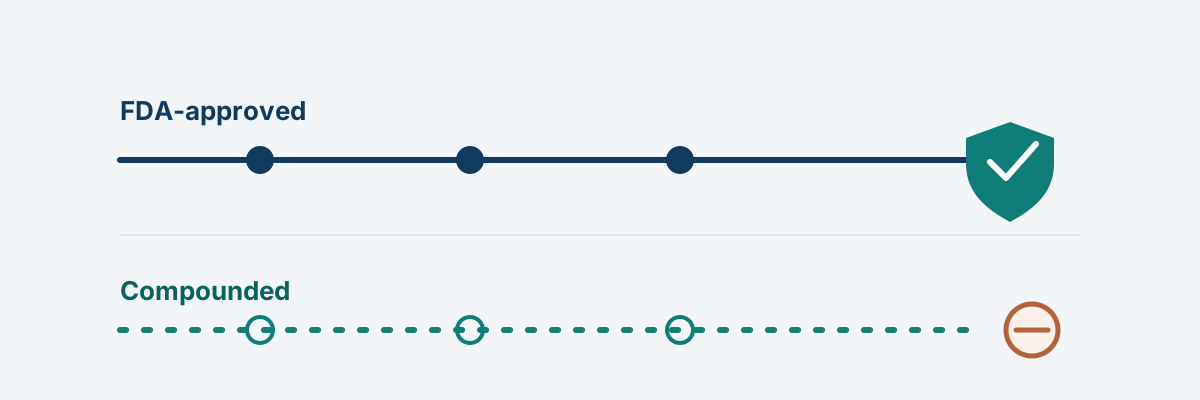
If you compare online weight-care programs, you will quickly meet two very different things that can look similar in an ad: FDA-approved GLP-1 medications and compounded GLP-1 products. Understanding the difference is one of the most important steps you can take.
We want to be precise here, because the distinction is often blurred in marketing.
What “FDA-approved” means
An FDA-approved medication has gone through the FDA’s review process, which evaluates evidence for safety and effectiveness for specific uses, along with standards for manufacturing quality and labeling. You can look up a product’s approval status through the FDA’s Drugs@FDA database.
Approval is tied to a specific manufacturer, formulation, and set of approved uses, not simply to an active ingredient.
What “compounded” means
Compounding is the practice of a licensed pharmacy preparing a medication to meet a particular need, for example, when a patient cannot use a standard product. Compounded drugs serve a real purpose, but it is essential to understand their regulatory status:
Compounded drugs are not FDA-approved. The FDA does not review them for safety, effectiveness, or quality before they reach patients.
That does not make every compounded preparation inappropriate. It does mean the safeguards are different, and the responsibility placed on the prescriber and pharmacy is greater.
Why they are not interchangeable
It is not accurate to say a compounded product is “the same as” an approved brand, even when it involves a similar active ingredient. Differences can exist in:
- formulation (including salt forms or added ingredients);
- strength and dosing;
- manufacturing controls and testing;
- labeling and instructions.
Because compounded products are not reviewed by the FDA in the same way, equivalence should not be assumed. If a program suggests the two are identical, that claim deserves scrutiny.
Two kinds of compounding pharmacies
Not all compounding is the same. U.S. law describes two broad categories, and it is reasonable to ask which one is preparing your medication:
- 503A pharmacies compound for an individual patient based on a prescription. They are overseen largely at the state level.
- 503B outsourcing facilities can compound in larger batches and register with, and are inspected by, the FDA, with additional manufacturing-quality expectations.
Neither category makes a product “FDA-approved”, approval applies to specific manufactured drugs, not to compounding. But the category, the pharmacy’s name, and its record are all fair things to ask about before you accept a product.
Why compounded versions appear
Interest in compounded GLP-1 products has been tied in part to periods of high demand and drug shortages. When a medication is in shortage, the rules about what may be compounded can change; when a shortage resolves, they can change again. Availability and the applicable rules therefore shift over time.
Because of that, the picture can look different from one month to the next, another reason to confirm current specifics with primary sources rather than rely on an older article or ad. A price that looks unusually low may reflect a compounded product rather than an approved one; that is not automatically wrong, but you should know which you are being offered.
How to check what you are actually getting
You do not have to be an expert to do basic due diligence:
- Ask the program to name the exact product and whether it is approved or compounded.
- Look up an approved product’s status yourself in the FDA’s Drugs@FDA database.
- Ask which pharmacy dispenses it, and whether it is a 503A pharmacy or a 503B facility.
- Keep the answers in writing (a message or email), so expectations are clear.
If a program cannot or will not tell you these things plainly, that is meaningful information in itself.
Questions worth asking
Before starting any GLP-1 medication through a program, ask the prescriber and pharmacy to confirm, ideally in writing:
- Is the product you would dispense FDA-approved, or compounded?
- If compounded, which pharmacy prepares it, and under what category of compounding?
- What is the exact active ingredient, form, and strength?
- How are quality and sterility handled?
- Who do I contact about side effects or problems?
These questions are covered alongside others in Questions to Ask Before Choosing an Online Weight-Care Provider.
Common questions
Is a compounded GLP-1 “fake”? No. Compounding is a legitimate, regulated pharmacy practice. The key point is narrower: a compounded product is not FDA-approved and is not reviewed by the FDA the same way, so it should not be described as identical to an approved medication.
Is compounded automatically cheaper or worse? Price differences can exist, but price alone tells you nothing about whether a product is right for you. Focus on what it is, who makes it, and what your clinician advises.
How do I know which I’m getting? Ask directly, and get the answer in writing. A trustworthy program will tell you plainly.
The bottom line
Both approved and compounded medications exist within the healthcare system, but they are not the same, and they should not be presented as equivalent. Knowing which one a program offers, and being able to discuss it with a licensed clinician, is central to making an informed choice. For how we weigh this in assessments, see How We Review.
Limitations & uncertainty
This is general education, not clinical or legal guidance. The rules around compounding, drug shortages, and availability change over time and can differ by state and pharmacy type. Verify the current status of any specific product with the FDA, the prescribing clinician, and the dispensing pharmacy.
Sources
We link to primary sources where possible. Any source we have not yet independently confirmed is labeled Not yet verified.
- Human Drug Compounding, U.S. Food & Drug Administration (FDA)Not yet verified
- Compounding and the FDA: Questions and Answers, U.S. Food & Drug Administration (FDA)Not yet verified
- Drugs@FDA: FDA-Approved Drugs (approval status lookup), U.S. Food & Drug Administration (FDA)Not yet verified