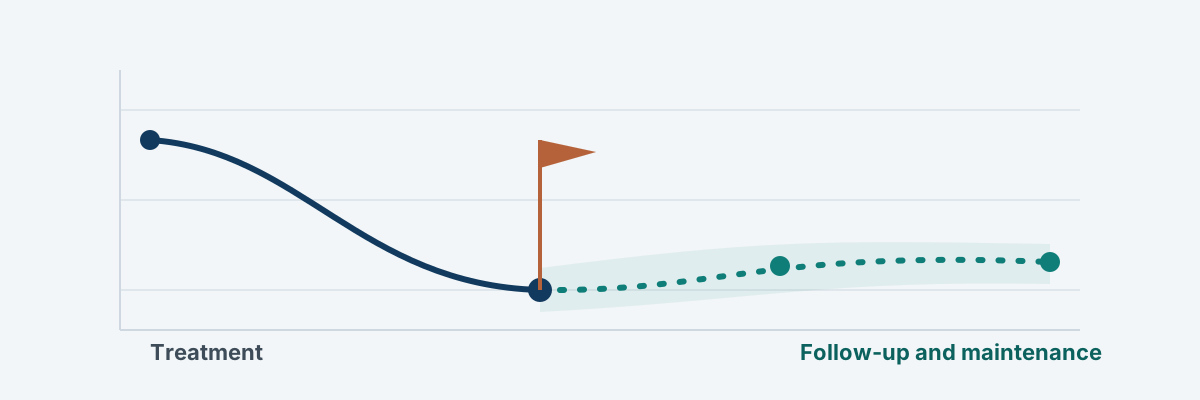
One of the most common, and most important, questions about GLP-1 medications is what happens when you stop. It is worth answering carefully, because the honest summary is nuanced.
What the research generally indicates
Clinical trials that followed participants after they discontinued a GLP-1 medication have generally reported partial weight regain over the months that followed. In other words, a meaningful share of the weight lost during treatment tended to return once the medication and its accompanying lifestyle support ended.
We are intentionally not quoting a precise percentage here. The exact figures depend on the specific trial, medication, dose, population, and follow-up length, and we would rather you see the number in its original context than trust a rounded stat. The primary publications are listed under Sources and are marked for verification.
How to read these studies carefully
Research averages are easy to misread, so a few points are worth keeping in mind:
- Trials measure groups, not you. A reported average describes what happened across many participants; your own result could be very different.
- Study designs differ. Follow-up length, whether lifestyle support continued, the specific medication and dose, and who was enrolled all shape the numbers. Two headlines can describe two different studies.
- “Regain” is not all-or-nothing. Partial regain still leaves some people below where they started; others return closer to baseline. The distribution matters, not just the average.
When you see a striking figure quoted online, it is worth asking: from which study, over how long, and in whom? That is exactly why we point to primary sources rather than repeating a number out of context.
Why this happens
The leading explanation is that obesity behaves like a chronic condition influenced by biology, not simply a matter of willpower. GLP-1 medications act while they are being taken; when they are stopped, the underlying drivers of appetite and weight regulation can reassert themselves. This is one reason clinicians increasingly discuss these treatments as long-term rather than short courses.
What this does not mean
A few careful caveats:
- It is not a guarantee for any individual. Trial averages describe groups, not a specific person’s future.
- It does not mean the treatment “failed.” Managing a chronic condition often involves ongoing treatment.
- It does not mean stopping is wrong. There are many valid reasons to stop, including side effects, cost, or a clinician’s advice. The point is to plan for it.
What clinicians and researchers discuss
Because this is an active area, approaches continue to evolve, and any plan should be individualized with a clinician. Broadly, the conversation tends to include:
- treating weight as a long-term condition, with ongoing rather than one-off care;
- attention to habits and lifestyle alongside any medication;
- thoughtful dose decisions, including how changes are managed over time;
- honest planning for cost and access so a plan is sustainable.
We are deliberately not prescribing a strategy here, that is not our role, and the right approach depends on your health, preferences, and clinician’s judgment. What we can say is that “what happens if I stop?” is a reasonable question to raise before starting, not after.
Practical implications when comparing programs
If maintenance matters to you, it is fair to ask a program how it handles the long term:
- Does it support ongoing care, or is it built around a short promotional period?
- How does it approach dose changes and eventual tapering, if relevant?
- What is the cost over a year or more, not just the first month? (See our pricing guide.)
These questions connect directly to the structural comparison we recommend for any GLP-1 program.
The honest bottom line
Current research points toward weight regain being common after stopping a GLP-1, which is why many clinicians frame these medications as part of long-term care. But the evidence is still developing, individual results differ, and the figures deserve to be read in their original sources.
Most importantly, decisions about starting, continuing, or stopping a medication should be made with a licensed clinician who knows your health history, not based on a general article. For how we assess the way programs handle long-term care, see How We Review.
Limitations & uncertainty
Findings summarized here come from specific clinical trials with defined populations and follow-up periods; they may not generalize to everyone, and the evidence continues to evolve. Exact figures should be confirmed against the primary publications, which are marked for verification below. This is general education, not medical advice.
Sources
We link to primary sources where possible. Any source we have not yet independently confirmed is labeled Not yet verified.
- STEP 1 trial extension, weight change after withdrawal of semaglutide (Diabetes, Obesity and Metabolism, 2022). Confirm citation and DOI/PMID., Peer-reviewed journal via NIH PubMedNot yet verified
- Prescription Medications to Treat Overweight & Obesity, NIH, NIDDKNot yet verified
- Obesity as a chronic condition, overview, U.S. Centers for Disease Control and Prevention (CDC)Not yet verified