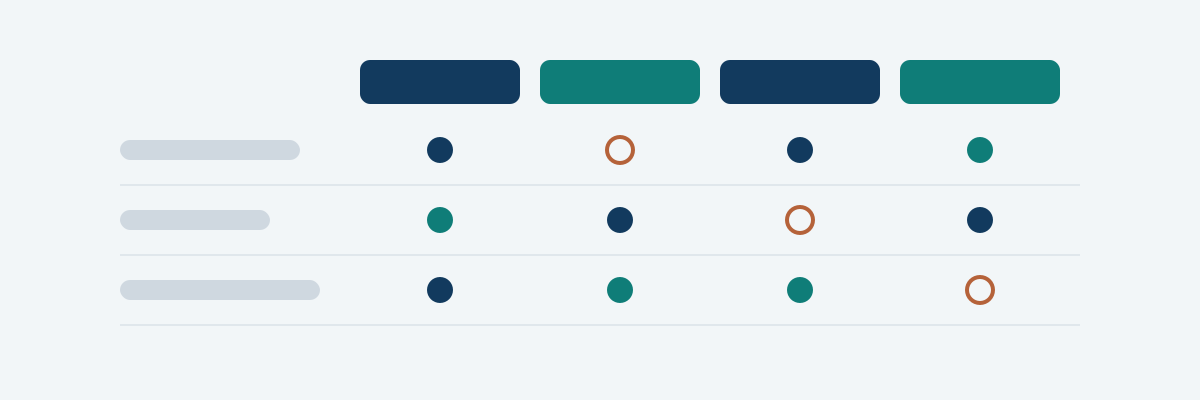
GLP-1 medications have made online weight-care programs one of the fastest-growing corners of telehealth. But “a GLP-1 program” is not a single product. It is a bundle of services, an intake questionnaire, a clinician review, a prescription (if appropriate), a pharmacy, ongoing check-ins, and billing, and each program assembles that bundle differently.
Before you compare prices, it helps to compare structure. The list below mirrors the framework we use in How We Review, and it is designed to help you ask better questions, not to point you toward any particular provider.
What a GLP-1 medication is, in brief
GLP-1 (glucagon-like peptide-1) receptor agonists are a class of prescription medicines. Some are approved by the U.S. Food & Drug Administration (FDA) for chronic weight management, and others for type 2 diabetes. They are prescription-only for a reason: eligibility, dosing, and safety depend on your individual medical history, and they carry contraindications and possible side effects.
What matters for comparing programs is simple to state: a GLP-1 program is a way to access a possible prescription and the care around it. Whether a medication is appropriate for you is a clinical decision that belongs with a licensed clinician who knows your history, not with an advertisement. For the medical background itself, reputable starting points include the NIDDK overview listed in our sources.
Who actually prescribes
A legitimate program routes your intake to a licensed clinician who can decide whether a prescription is appropriate for you. Look for clarity on:
- whether a clinician is licensed in your state (telehealth prescribing is regulated at the state level);
- whether a real person reviews your history, rather than an automatic approval;
- whether you can ask questions before and after a prescription, and how;
- how the program handles side effects, dose changes, or a decision not to prescribe.
If a service implies you are guaranteed a specific medication regardless of your health history, treat that as a warning sign rather than a convenience. A clinician who is willing to say “this may not be right for you” is doing their job.
What medication is dispensed, and where it comes from
This is the single most important disclosure. Programs may dispense FDA-approved branded medications, or compounded products, which are prepared by a pharmacy and are not FDA-approved and not evaluated by the FDA for safety, effectiveness, or quality in the same way. These are not interchangeable, and a lower price often reflects this difference.
We cover this in detail in Compounded vs. FDA-Approved GLP-1 Medications. At minimum, a program should state plainly:
- whether you would receive an approved or a compounded product;
- which pharmacy prepares or dispenses it;
- the exact ingredient, form, and strength.
If those answers are hard to find before you pay, that is itself informative.
The total cost, not the teaser price
Advertised prices frequently exclude parts of the real cost. When comparing, add up:
- the membership or consultation fee;
- the medication cost, and whether it can change month to month or with dose;
- lab work, shipping, or “provider messaging” fees;
- what happens to the price after any introductory period.
Our pricing guide breaks down the fees that are easy to miss and shows how to build a single, comparable “all-in monthly” figure for each program.
You can also use the GLP-1 Program Cost Calculator to inspect current published plan totals, commitments, and renewal terms without entering medical information.
Ongoing support and monitoring
Weight care is not a one-time transaction. Compare how each program handles follow-up:
- Are dose adjustments guided by a clinician?
- Is there timely side-effect support, and how do you reach it?
- Are check-ins with a clinician, or automated messages?
- Is any monitoring (labs, weight, blood pressure) included?
Thin follow-up can make an inexpensive program more costly, in money and in stress, over a year.
Eligibility and safety information
GLP-1 medications carry contraindications and possible side effects, and they are not appropriate for everyone. A responsible program screens for eligibility rather than treating every visitor as a candidate, and it surfaces safety information clearly instead of burying it.
When you review a program, notice whether it:
- explains who should not take these medications;
- describes common side effects in plain language;
- tells you what to do if you have a bad reaction.
We deliberately do not list specific side-effect rates here; those belong in the official prescribing information and should be discussed with your clinician.
Cancellation, refunds, and your data
Before entering payment details, read:
- how you cancel, and whether it can be done without a phone call;
- refund terms for unused or undelivered medication;
- the privacy policy: what health information is collected, and with whom it is shared.
A subscription that is easy to start and hard to stop deserves extra scrutiny.
Red flags worth slowing down for
None of these alone proves a program is bad, but together they are reasons to pause:
- pressure to decide quickly, or countdown timers on medical decisions;
- guaranteed results or dramatic before/after claims;
- vagueness about whether the medication is approved or compounded;
- no clear way to reach a clinician after you pay;
- a price that only becomes clear after you enter payment details.
A simple way to compare two programs
You do not need a spreadsheet, just a consistent grid. For each program, fill in the same rows:
- Clinician licensed in my state? (yes/no/unclear)
- Medication: approved or compounded? Which pharmacy?
- All-in monthly cost after any promo.
- Follow-up: clinician or automated? How to reach help?
- Cancellation and refund terms.
- What the privacy policy says about my data.
Comparing the same rows across programs is far more useful than comparing marketing pages. If one program leaves several rows blank because the information is hard to find, that pattern tells you something.
A short pre-join checklist
- Is a clinician licensed in my state involved?
- Is the medication FDA-approved or compounded, and is that stated up front?
- What is the total monthly cost after any promo?
- How do follow-up and side-effect support work?
- How do I cancel, and what is refundable?
- What does the privacy policy say about my data?
If a program answers these clearly, you can compare it fairly against others. If it dodges them, that is useful information too. When you are ready to go deeper, see our list of questions to ask a provider and the criteria we use in How We Review.
Limitations & uncertainty
This guide explains categories to compare, not a ranking of specific programs. Prices, eligibility rules, and included services change frequently and vary by state; confirm current details directly with each provider and with a licensed clinician before deciding. Nothing here is a recommendation to start, stop, or choose any specific medication or program.
Sources
We link to primary sources where possible. Any source we have not yet independently confirmed is labeled Not yet verified.
- Prescription Medications to Treat Overweight & Obesity, NIH, National Institute of Diabetes and Digestive and Kidney Diseases (NIDDK)Not yet verified
- Drug Safety and Availability (GLP-1 communications), U.S. Food & Drug Administration (FDA)Not yet verified
- Telehealth: what to know as a patient, U.S. Department of Health & Human Services, Telehealth.HHS.govNot yet verified
- Health claims in advertising, guidance for marketers, U.S. Federal Trade Commission (FTC)Not yet verified